
Barcelona, January 8, 2020.- Quote: «Everybody likes to get a package. In 2020, we’ll send more than 100 billion of them — and that number could double by 2030. Who will deliver all those packages, and how?«.
In this way so suggestive and interesting starts a McKinsey & Company report. They wonder about the evolution of drones and the last mile. A mode of transport with which I still maintain my caution about its massive expansion to all consumers. However, the drone begins to become a standard for certain small goods routes. If we put aside Amazon projects, it is possible that in the medium term the mailman does not knock twice at the door of our home.
Next, I reproduce the options of Ludwig Hausmann and Florian Neuhaus are both partners in McKinsey’s Munich office, Neelesh Mundra is a partner in the Mumbai office, and John Murnane is a senior partner in the Atlanta office.
In this way so suggestive and interesting starts a McKinsey & Company Report. The wonder about the evolution of drones and the last mile. http://www.victorvilas.com
Tweet
Drones, droids, and more
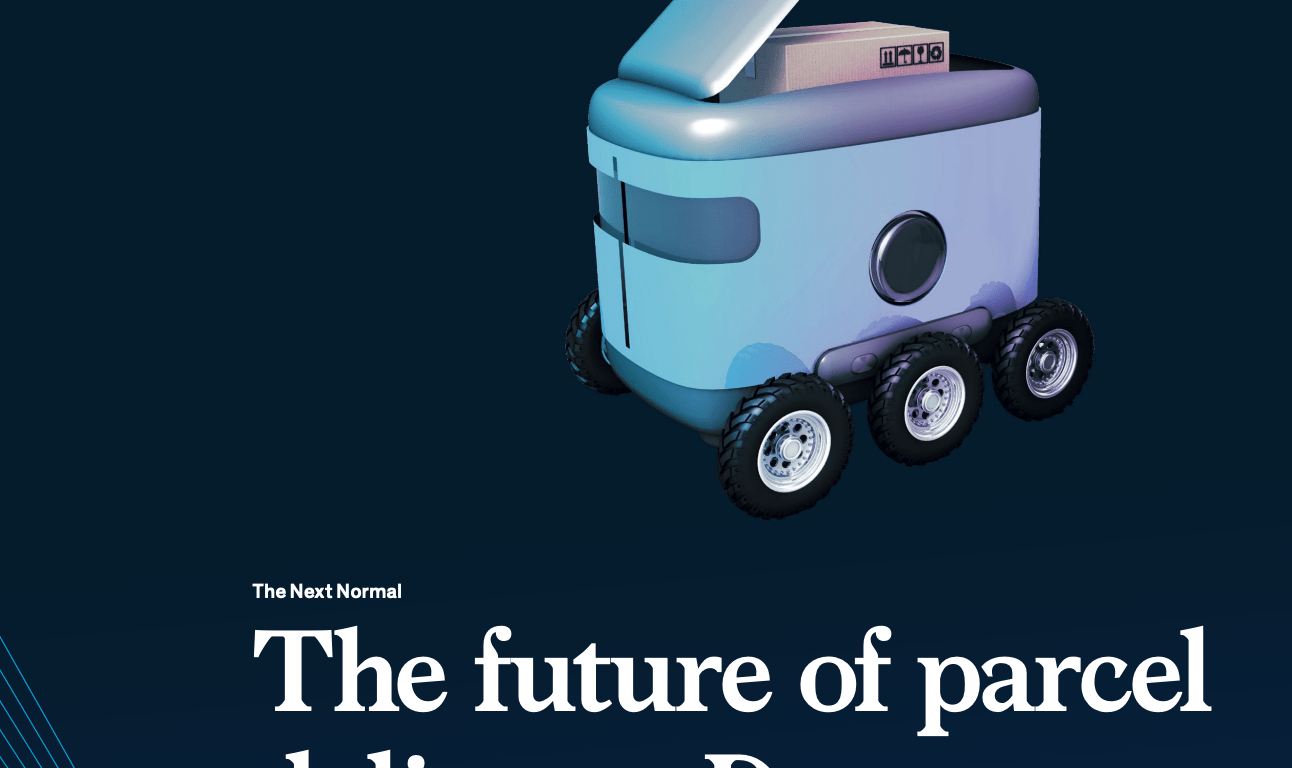
- Ludwig Hausmann: There are a lot of machines that are being talked about. There are drones. There are droids: small robots walking the streets. Then there could be parcel lockers—not stationary ones, but ones that are mounted on top of autonomous vehicles and circulate 24/7 in residential areas.
- John Murnane: I think you will see drones. Maybe not drones flying from a warehouse in the suburbs, over the city, and into your home. But I think you’ll see, within residential-delivery networks, a truck pull up with ten drones that go out and deliver to each of the locations, just to get scale in the economics of delivery.
- Neelesh Mundra: One of the biggest technology advancements for delivery by 2030, potentially, is going to be drones extending reach in India, which has always been a struggle for typical parcel-delivery players.
- Florian Neuhaus: What parcel delivery could look like is that you have a central place—maybe for all communities—and there’s a street, and you have one drop-off place. There will be robots that basically pick up the stuff from there, bring it to our homes, and put it in our fridges, because we’ll all own robots that make our bed, do the laundry, whatever.
- Ludwig Hausmann: In China, people are talking about tunnels where parcels will shoot up to the basement of big apartment buildings, so they don’t even congest or hit the roads at all.
Delivery from local stores
- Neelesh Mundra: Can I actually deliver offline from the local mom-and-pop store? That momand-pop store then becomes the delivery agent for that particular locality. The beauty of that is, the efficiencies are so high because that mom-and-pop store owner individually knows the people in the locality, so the chance of a delivery attempt being a failure is almost nil. So I think that the disruption of using online to offline is probably going to be one of the big things for Indian companies in the next four or five years. Last-mile package delivery in 2030 Four McKinsey partners talk drones and disruption. December 2019 | Video transcript 2 The future of parcel delivery: Drones and disruption
- Ludwig Hausmann: You enable stock that’s out there in the store and behind the storefront in the city; you make that available for online shopping and get it delivered same day. This is something parcel companies need to find a solution for—that they have dual sourcing, both from distribution centers and also from local stores, but in an economical, consolidated, milk-run-type fashion. And that’s what a lot of smart people are working on these days.
Tomorrow’s workforce
- John Murnane: The core employee at a major integrator or parcel company is going to look more like a data and analytics hound than, you know, customer-service oriented—getting out in the field, working in the sun. And so I think these companies do need to figure out how to change the culture of their organization because it’s going to be more analytically driven.
- Neelesh Mundra: India’s got a large population and a large young population. What I see is that this population is going to want to do freelance work. What that’s going to mean is that even if you are going to college from 9:00 a.m. to 5:00 p.m., from 5:00 p.m. to 8:00 p.m., you may decide to be a delivery person for your locality, which you know better than anyone else.

Shocks and disruptions
- John Murnane: I think there’s a chance for one of the incumbents or one of the new entrants to emerge and really create a distinctive enough offering that is personal, that is trusted, that is customized, where a consumer’s loyalty becomes to that logistics provider. The customer says, “Look, I have a weekly delivery by my logistics provider, and so the retailers, the grocers, the whatever—you’re going to fit into that.” That would be disruptive. And I think there’s the potential for that to happen.
- Florian Neuhaus: I could think about 3-D printing, right? If you could locally produce, in your house, anything that you need, it would change the entire landscape of last-mile delivery, the entire landscape of supply-chain warehousing right now. Now, current predictions, I think, are that up to 30 percent or 35 percent of items can be 3-D printed. But, I mean, if you think about a “black-swan event,” yes, maybe we could go further with that. And that would change everything.
More Information:
- Principales ventajas de contratar hoy e-TMS AndSoft para su empresa de transporte
- ¿Por qué el Excel ya no basta en la Logística Moderna?
- AndSoft presentará las últimas innovaciones de eTMS en Solutrans 2025, (Hall 1, C046), del 18 al 22 de noviembre
- Las 44 toneladas elevarán los costes de los transportistas hasta un 18%
- Aparcamientos seguros para camiones gracias a la digitalización
- Conclusiones del IV Foro de Transporte del Centro Español de Logística
- El comercio digital aumentará un 5,4% en España durante 2025
- UNO: «Hay que evitar que la sostenibilidad afecte negativamente a la rentabilidad de las empresas de transporte»
- La AET propone un clúster portuario entre Galicia y el Norte de Portugal
- Coyuntura de la logística de última milla durante 2025
- Claves que afectarán al transporte de mercancías durante 2025
- España + Portugal = Región logística única
- OMI: «Aún presencia humana en los buques autónomos»
- Víctor Vilas, BDM at AndSoft, elegido Vocal de la Junta Directiva del Cluster Catalonia Logistics
- 39 millones de euros más en fondos europeos para la digitalización del transporte

 Víctor Vilas AndSoft TMS Software PARA TRANSPORTISTAS